Whimsical Kids Clipart Pack
A Designer’s First Look: Light, Loose, and Full of Quiet Charm
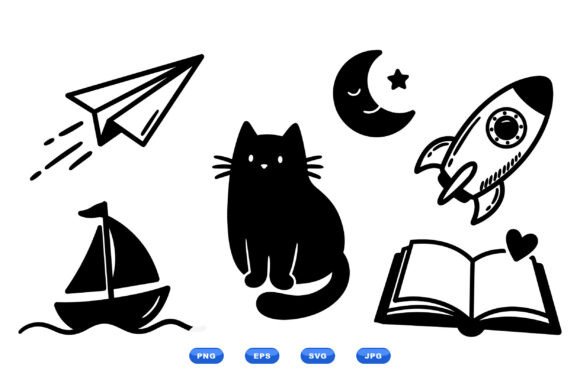
Opening the Whimsical Kids Clipart Pack feels like flipping through a child’s sketchbook—soft lines, gentle curves, and just enough detail to spark imagination without overwhelming the eye. The sitting cat, paper plane, rocket, sailboat, open book, and crescent moon aren’t fussy or hyper-rendered. They’re line art vectors with breathing room: no heavy shadows, no intricate gradients, no tiny decorative flourishes that would vanish under thread. That’s not a limitation—it’s an invitation. This pack leans into simplicity as a strength, especially for embroidery where clarity trumps complexity.
Real-World Use: A Custom Embroidered Tote Bag for a Local Toy Shop
Last week, I prepped a small-batch order for a neighborhood toy shop: 25 canvas tote bags for their summer storytime series. They wanted something sweet but not cutesy—playful, gender-neutral, and legible at 3.5 inches wide. I tested Whimsical Kids Clipart Pack’s sailboat on scrap canvas first. Its clean outline held up beautifully in satin stitch, and the subtle curve of the hull translated cleanly into smooth, continuous stitching. No skipped stitches, no thread breaks—even on medium-weight unlined canvas. The open book worked equally well as a standalone chest emblem on a baby sweatshirt: its spine and pages read clearly at 2.75 inches, and the negative space between lines gave stabilizer room to breathe.
Where It Shines—and Where to Pause
Whimsical Kids Clipart Pack excels in low-density, high-readability applications: embroidered patches (especially iron-on or sew-on cotton twill), tea towel corners, pillow covers with linen backing, and nursery wall hangings. It’s ideal for baby embroidery and holiday embroidery where softness and sincerity matter more than flash. The crescent moon, for instance, stitched flawlessly on a stretchy knit onesie—its open shape avoided puckering, and its thin line stayed crisp with a lightweight cutaway stabilizer.
But be mindful: the paper plane’s wingtips and the cat’s ear tips are delicate. On textured fabrics like terry cloth or thick fleece, those fine points can blur or fray slightly after washing. Likewise, on dark fabric, avoid ultra-light thread unless you’ve tested contrast—some lines disappear if your fill stitch density is too low or your stabilizer too stiff. And while it works on curved surfaces like caps, keep placements above the crown seam; the rocket’s narrow tail narrows further when hooped on a cap frame, risking distortion.
Stitching Clarity Meets Customer Trust
What makes Whimsical Kids Clipart Pack stand out isn’t just how it stitches—it’s how it *feels* in the finished product. Customers notice when embroidery looks intentional, not rushed. These designs land with quiet confidence: no visual noise, no competing elements. That builds trust—especially for Etsy sellers and small shop owners who rely on repeat buyers and word-of-mouth. A personalized gift stitched with the sitting cat feels thoughtful, not generic. A boutique apron featuring the open book reads as curated, not clip-art-casual. That distinction elevates your handmade product from “cute” to “crafted.”
Practical Notes Every Embroidery Designer Should Check
- Test on scrap fabric first—especially if using stretchy, napped, or dark substrates. Line art can behave differently depending on thread tension and stabilizer combo.
- Review stitch density before scaling. These are vector-based line art files, so they’ll scale cleanly—but dense fill areas (like the rocket’s body) may need manual simplification if going below 2 inches.
- Confirm hoop size compatibility. Most motifs fit comfortably in a 4x4 hoop, but the sailboat + crescent moon combo (if grouped) may require a 5x7 for balanced spacing.
- Inspect small details at actual stitch-out size—not just on screen. The cat’s whiskers, for example, are thin but legible at 3 inches; at 1.5 inches, they risk becoming indistinct without a running stitch reinforcement.
- Try black-and-white mockups to assess contrast and balance. These designs rely on shape and rhythm, not color—so if it reads well in grayscale, it’ll translate across thread palettes.
- Use proper stabilizer: medium-weight tear-away for stable wovens, cutaway for knits, and lightweight mesh for sheer fabrics like voile baby blankets.
- Verify licensing before selling finished items or bundling into digital embroidery files. Since Whimsical Kids Clipart Pack is categorized under Graphics and Crafts, confirm whether commercial use is included—especially for Etsy sellers bundling it into craft kits or printable mockups.
Beyond the Hoop: Branding, Gifting, and Longevity
This pack doesn’t scream. It smiles. That subtlety makes it unusually versatile for craft business branding—think minimalist shop tags, understated packaging seals, or quiet embroidery accents on organic cotton market bags. It also layers well: pair the open book with hand-lettered text for a literary baby shower gift, or combine the crescent moon and sitting cat for a calming bedtime-themed pillow cover. Because the motifs share a consistent line weight and visual rhythm, they feel like part of a family—not a random collection. That cohesion strengthens brand consistency across products, whether you’re designing custom apparel or holiday embroidery bundles.
And longevity? These shapes won’t date quickly. Unlike trend-driven graphics, Whimsical Kids Clipart Pack leans into timeless storytelling cues—the rocket, the sailboat, the crescent moon—that resonate across generations. That means your finished product holds value longer, your customers keep it longer, and your small shop product stays relevant season after season.
Final Thought: Simplicity, Done Right, Is Anything But Simple
Whimsical Kids Clipart Pack isn’t flashy—but then, neither is great embroidery. It’s precise, adaptable, and deeply considerate of how real thread meets real fabric. If you’re choosing design assets for embroidered patches, baby embroidery, or small-batch merchandise, this pack earns its place not because it’s easy to use, but because it’s easy to *trust*. It respects your time, your machine, your fabric—and most importantly, the person receiving the finished product.