Kitchen Doodle Clipart Set
First Impressions: Whimsy That Stitches Clean
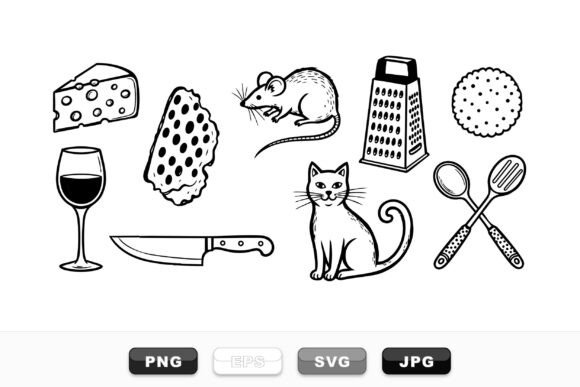
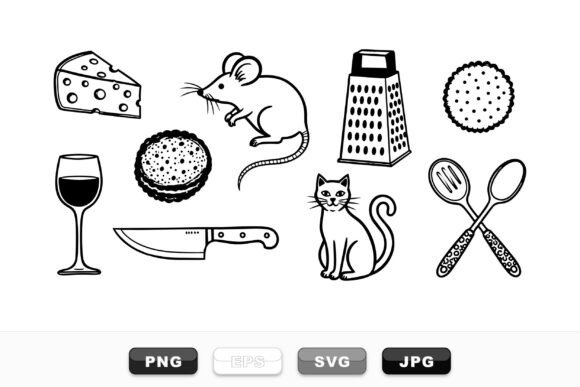
Opening the Kitchen Doodle Clipart Set feels like flipping through a well-loved sketchbook—light, confident, and full of quiet personality. These aren’t fussy illustrations; they’re black-and-white line art pieces with clear rhythm and intentional simplicity: a cheeky mouse peeking from behind a wedge of cheese, a wine glass tilted just so, crossed spoons that read as both playful and functional. The style lands squarely in “hand-drawn charm,” not cartoon overload—and that matters deeply when translating to stitch. As an embroidery designer who’s stitched everything from nursery pillows to boutique aprons, I immediately saw how this set could breathe life into real handmade products without overwhelming the fabric or the wearer.
A Real Project Test: Embroidering a Linen Kitchen Towel
Last week, I used the cheese and crossed spoons motifs from the Kitchen Doodle Clipart Set on a 100% linen tea towel for a local kitchenware pop-up. Why linen? Because it’s unforgiving—loose weaves catch threads, uneven tension shows fast, and thin lines either vanish or bleed. The clean outlines held up beautifully. No pixelation, no muddy junctions. When digitized (I used a standard 3-step satin stitch for edges and light fill for the cheese rind), the shapes retained their character at 2.8" wide—just right for a towel corner or hem accent. Customers didn’t just notice it—they smiled, picked it up, and asked, “Is that hand-drawn?” That’s the signal: this set doesn’t scream “clipart.” It whispers “made with care.”
Where It Shines—and Where to Pause
The Kitchen Doodle Clipart Set excels in projects where warmth and approachability matter most: embroidered baby bibs with the tiny mouse motif, cotton tote bags featuring the grater + cookie combo, or unisex sweatshirts with the wine glass centered on the chest. Its minimal line weight makes it ideal for applique design foundations, small hoop embroidery (under 4"), and layered stitching on medium-weight fabrics like quilting cotton or midweight twill.
But be thoughtful: avoid placing the cat or mouse outline on highly textured terry cloth—it’ll lose definition. Skip dense fill stitches inside the cheese wedge on stretchy jersey; opt instead for a running stitch outline or open satin border. On dark fabric, test thread contrast first—the fine lines need strong tonal separation. And while the crossed spoons read clearly at 3", they’ll blur if shrunk below 1.5" on a cap visor or curved surface. This isn’t a limitation of the design—it’s a reminder that machine embroidery design is a collaboration between art and physics.
What It Adds to Your Finished Product
Customers don’t buy clipart. They buy feeling—and the Kitchen Doodle Clipart Set delivers quiet confidence. A personalized gift embroidered with the wine glass + cheese motif reads as curated, not generic. An Etsy seller using these as part of a holiday kitchen bundle (think: embroidered oven mitt + matching tea towel) builds cohesive design assets without licensing headaches—provided commercial use is confirmed. For craft business owners, this set strengthens brand consistency across product lines: same visual voice on patches, apparel, and printable mockups. Most importantly, it elevates perceived value. A simple black-and-white line art motif, well-stitched, says “this was chosen, not dumped.” That builds trust faster than any tagline.
Practical Designer Notes You’ll Actually Use
- Always test on scrap fabric first—especially with linen, terry, or blends. Watch how fine lines behave after washing.
- Review stitch density before finalizing. Lighter fills keep the doodle feel; heavy fills mute the sketch-like charm.
- Confirm hoop size compatibility. These scale well, but tight corners (like the curve of the grater) may need slight cleanup in your embroidery software.
- Inspect small details: the mouse’s tail, the knife’s handle notch, the cookie’s crumb texture—do they translate cleanly at your intended size?
- Test black-and-white mockups on both light and dark backgrounds. Line art relies on contrast—not color—to communicate.
- Use appropriate stabilizer. Tear-away works for stable wovens; cut-away adds security for knits or frequent-wash items like baby embroidery.
- Verify licensing before selling finished products or bundling the digital embroidery file into kits. Since this is listed under Graphics, confirm whether redistribution or derivative digital sales are permitted.
Not Just for Totes and Tea Towels
This set quietly expands what “kitchen-themed” can mean. I’ve used the cat motif on a child’s apron (scaled large, with soft satin borders), the wine glass as a subtle chest accent on a women’s chambray shirt, and the crossed spoons as a repeating border on a quilted oven mitt. It works for holiday embroidery—imagine the cheese and cookies on a linen stocking—but also for wedding gifts (a monogrammed towel with the wine glass + initials). Even in nursery decor, the mouse and cat read gently, not cloyingly. As a digital product seller, I’d pair these with coordinating SVGs or watercolor textures—but only because the line art stands strong enough to anchor the collection, not fade into the background.
Final Thought: Simplicity With Substance
The Kitchen Doodle Clipart Set won’t wow with flash—but it earns respect with reliability. It’s the kind of embroidery file you return to again and again because it stitches cleanly, sells consistently, and fits naturally into handmade product stories. Whether you’re an Etsy seller building a cohesive shop, a small shop owner curating boutique merchandise, or a hobbyist stitching personalized gifts, this set gives you flexibility without compromise. It’s not filler. It’s foundation—with a wink.